2026 numbers · Free to share
Room for
a car seat?
Back-seat legroom and width for every 2026 midsize body-on-frame crew cab, next to the full-size half-tons. Written by Beach 4x4, 6+ years renting four-wheel-drive vehicles on the Outer Banks.
Why we made this
The car seat question
Families renting a truck from us ask it all the time: will a car seat fit? In a midsize truck it usually installs fine. Then the trip starts. What we see: the kid can't stretch out, and the feet end up in the back of the front seat for the whole drive.
Every midsize crew cab has five seat belts, so the brochures look alike. Back-seat legroom doesn't. Here it is, from each maker's published specs, side by side.
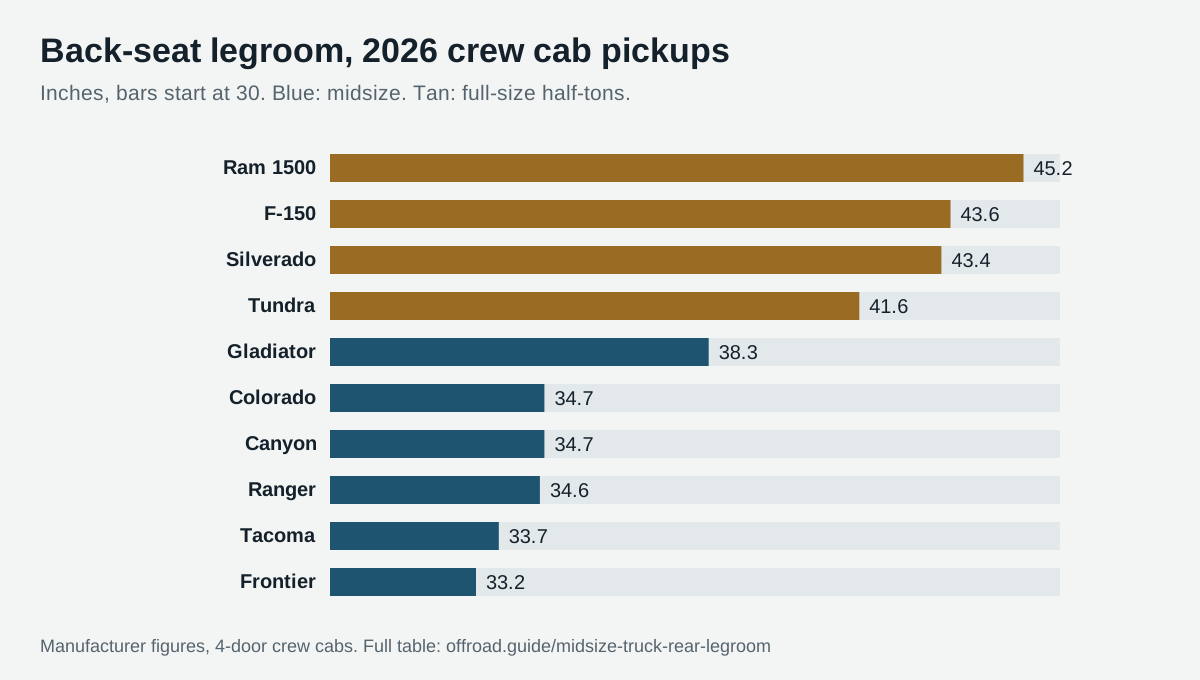
The Gladiator's back-seat legroom, 3.6 inches more than any other 2026 midsize crew cab.
The gap between the tightest midsize back seat (Frontier, 33.2 inches) and the roomiest pickup back seat (Ram 1500, 45.2; some sources list 44.8).
The Frontier has the widest midsize back seat and the least legroom. Every full-size crew cab here is wider still, 62.4 to 66.0.
The chart
Back-seat legroom, 2026 crew cab pickups
Blue bars are midsize trucks; tan bars are full-size half-tons for scale. Bars start at 30 inches.
Second-row legroom, inches
Midsize crew cabFull-size crew cab
Three across
Back-seat width
Shoulder room is the best published clue to whether a car seat and two passengers, or two car seats and a booster, fit side by side. The seat model and buckle spacing matter too. Bars start at 54 inches.
Second-row shoulder room, inches
Midsize crew cabFull-size crew cab
With a car seat
What the numbers mean with a kid in the back
Forward-facing seats lift the child up and forward. Legroom is measured for an adult sitting on the cushion. A car seat sits the child higher and closer to the front seat, so their feet reach the seatback sooner. In a 33- or 34-inch back seat, that often means feet on the seatback. At 38 inches in the Gladiator, or 41 to 45 in a full-size crew cab, there is more room to stretch.
Rear-facing seats take room from the front. A rear-facing seat needs space between its back and the front seatback. In a tight back seat, the front seat slides forward to make room, and the driver or front passenger gives up legroom. More on rear-facing seats below.
Width matters with more than one seat. Car seats are wide at the base. The full-size trucks are 4 to 10 inches wider in back, which is the difference between three across and two plus a squeeze.
Bring the seat to the test drive. Install your own car seat with the front seat set where the driver actually sits, then put the child in it. Five minutes in the lot tells you more than any spec sheet. On our beach test drive the family comes along, so try it there.
Watch the trim. Toyota publishes the same 33.7 inches for the Tacoma TRD Pro, but reviewers note its bulkier shock-absorbing front seats cost the back seat some real-world room.
Rear-facing
Rear-facing seats need the most room
Rear-facing lasts longer than most parents expect. The American Academy of Pediatrics says to keep a child rear-facing until they reach the highest height or weight their seat allows, not a birthday. Many convertible seats let kids stay rear-facing well past age 2, sometimes to 3 or 4, depending on the child and the seat.
Front-to-back space varies a lot. In an older hands-on comparison, Car Seats for the Littles measured rear-facing convertibles from about 27 to 35 inches front to back, and stressed that the number changes with the vehicle and the recline. Some convertibles are built short front to back for exactly this. If a rear-facing seat needs more room than the truck gives it, the front seat has to move forward.
Legroom is a starting point, not a fit test. Our legroom figures are an adult’s seated measurement, not open floor space, so you can’t subtract a car seat from them. A tighter back seat generally leaves less to work with, but the seatback angle, the cushion shape and the car seat’s design matter too.
Can it touch the front seat? It depends on the car seat and the truck. Many brands allow light contact once the seat is installed tight. Dorel brands (Safety 1st, Maxi-Cosi, Cosco) go further and want an outboard rear-facing seat touching, or as close as possible to, the seat in front. Evenflo allows light contact for its rear-facing convertible and all-in-one seats but requires a 1.5-inch gap for its rear-facing-only infant seats in outboard positions. Light contact only: the front seat must not hold the car seat in place, push it more upright, or press on it. The truck’s owner’s manual can still forbid contact, so check both manuals.
Ways to buy room. Try both outboard positions; behind the front passenger is often easiest, since the driver’s seat is set by the driver. Raise or lower the front seat, not just slide it. Use the most upright recline the car seat allows for your child’s age and weight, and never go more upright than that to gain room; babies need the recline to keep their airway open.
Test it in the truck you’re buying. Install the seat where you’ll use it; it should move no more than 1 inch side to side or front to back at the belt path. Then set the front seat where that person actually sits, make sure they can sit upright with the belt fitting right, and recheck the car seat’s tightness and recline. Check where the truck has lower anchors; not every seating position has them.
All the numbers
2026 crew cab back-seat dimensions
Published manufacturer figures, 4-door crew cabs, not our own measurements. Scrolls sideways on a phone.
| 2026 crew cab, 4WD | Back-seat legroom (in) | Back-seat shoulder room (in) | Back-seat hip room (in) |
|---|---|---|---|
| Jeep Gladiator | 38.3 | 55.7 | 55.9 |
| Chevrolet Colorado Crew Cab | 34.7 | 56.1 | 53.1 |
| GMC Canyon Crew Cab | 34.7 | 56.1 | 53.1 |
| Ford Ranger SuperCrew | 34.6 | 56.7 | 54.1 |
| Toyota Tacoma Double Cab | 33.7 | 57.8 | 56.3 |
| Nissan Frontier Crew Cab | 33.2 | 58.3 | 53.7 |
| Ram 1500 Crew Cab | 45.2 | 65.7 | – |
| Ford F-150 SuperCrew | 43.6 | 66.0 | – |
| Chevrolet Silverado 1500 Crew Cab | 43.4 | 65.2 | – |
| Toyota Tundra CrewMax | 41.6 | 62.4 | – |
Ram lists 45.2 inches of rear legroom for the Crew Cab; some data sources list 44.8. The GMC Canyon shares the Colorado's cab. Unibody pickups (Maverick, Ridgeline, Santa Cruz) are left off. Full-size hip room left out where makers measure it differently. Compare more on Biggest 4x4s by real room, midsize off-road trucks, Wrangler vs. Gladiator and pickup or SUV for the family.
Questions
Quick answers
Which midsize truck has the most rear legroom?
The Jeep Gladiator, at 38.3 inches of back-seat legroom. The next closest 2026 midsize crew cabs are the Chevrolet Colorado and GMC Canyon at 34.7 inches, then the Ford Ranger at 34.6, the Toyota Tacoma at 33.7 and the Nissan Frontier at 33.2.
How much rear legroom does the 2026 Toyota Tacoma have?
The Tacoma Double Cab has 33.7 inches of back-seat legroom, 57.8 inches of shoulder room and 56.3 inches of hip room. Toyota's figure covers the TRD Pro too, but reviewers note its bulkier shock-absorbing front seats cost the back seat some real-world room.
Will a car seat fit in a Tacoma?
Yes, it fits and installs. The question is the child. With 33.7 inches of legroom, a forward-facing child's feet reach the front seatback, and a rear-facing seat can push the front seat forward. Install your own seat with the front seat set where the driver actually sits before you buy.
What is the best pickup truck for car seats?
By published dimensions, a full-size crew cab. The Ram 1500 Crew Cab has 45.2 inches of back-seat legroom (some data sources list 44.8), the F-150 SuperCrew 43.6 and the Silverado 1500 Crew Cab 43.4. That is 8 to 12 inches more than most midsize crew cabs, and the back seats are 4 to 10 inches wider.
Which midsize truck has the widest back seat?
By shoulder room, the Nissan Frontier at 58.3 inches, then the Tacoma at 57.8. The Gladiator, roomiest for legs, is the narrowest at 55.7.
Is the Gladiator back seat bigger than a Tacoma's?
For legs, yes: 38.3 inches against 33.7, a 4.6-inch difference. For width, no: the Tacoma's back seat is 2.1 inches wider at the shoulders.
Will a rear-facing car seat fit in a midsize truck?
Often, but it depends on the truck, the car seat and who rides up front. Midsize crew cabs have the tightest back seats here, 33.2 to 38.3 inches of legroom, so expect the front seat to give up room. Try both outboard positions, consider a seat that's short front to back, and test it with the front seat where that person really sits.
Can I use this chart on my site?
Yes. Copy the embed code on this page, or quote the numbers with a link back to OffRoad.guide.
OffRoad.guide · Open all year
Half a day on the sand. Then the price, in writing.
$325 a vehicle for the full five and a half hours, any month of the year. Request a date on the main page to get first pick. We email you to confirm it, with the booking link and the online license and insurance check. Questions? Email hello@offroad.guide; answers come back the same day.
Keys at the Hilton Garden Inn in Kitty Hawk, half a day up North Carolina Highway 12 and the Carova 4x4 beach, your family along and no salesperson. Then the No-Haggle Price in writing. The whole experience, start to finish.